
The Packed Lunch I Never Wanted to Make
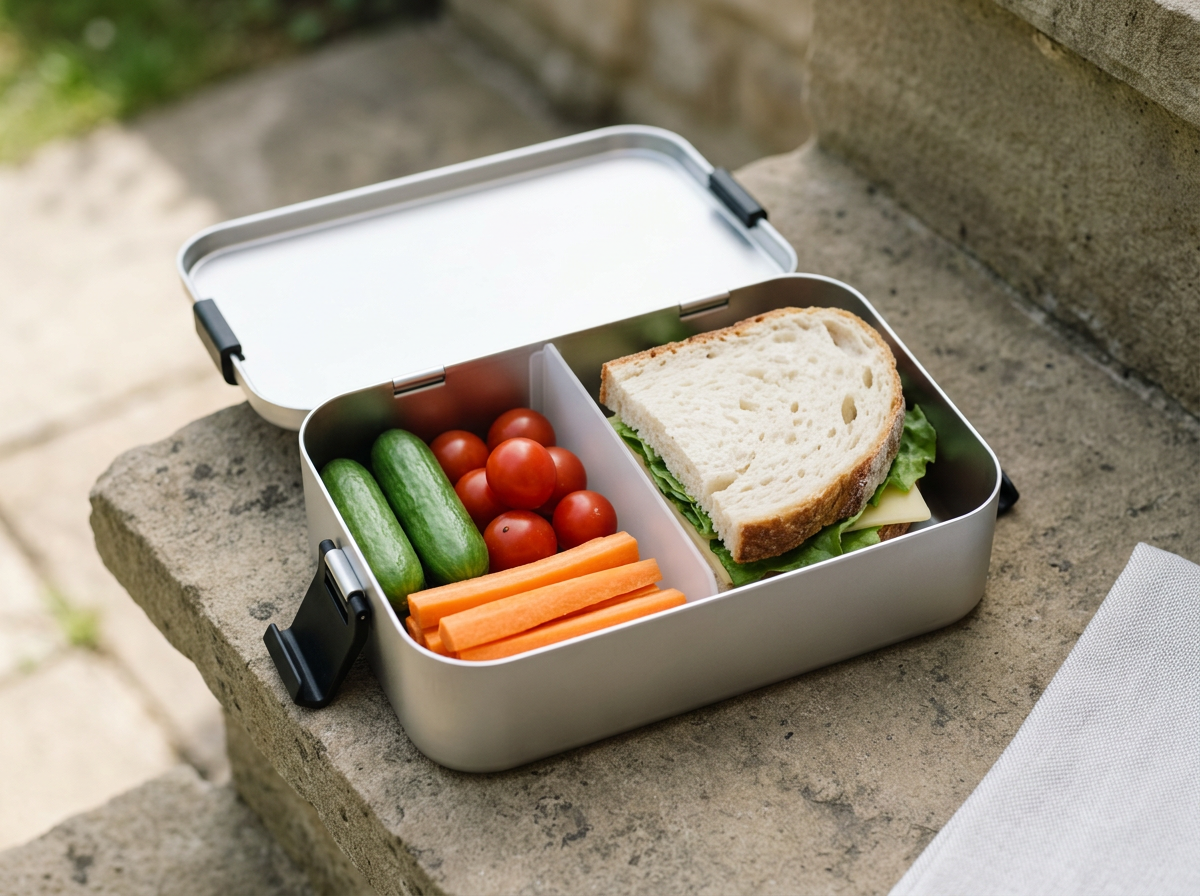
My school lunches were nothing to write home about. Grey trays, food I can barely remember, nothing that would earn a photograph today. Yet I looked forward to them every single day — not for what was on the plate, but for who was around the table. Twenty minutes of nobody comparing plates, because we were all eating the same thing. No negotiation, no performance, just time with friends that the rest of the school day didn't leave room for.
I didn't understand, at nine, that this was the point — that the food barely mattered, as long as everyone at the table was eating it. My own children never got the same chance to not notice. They started on school lunches, the way I assumed they would; sadly, it didn't last. The food was so poor that they simply stopped eating it — not fussiness, just food that wasn't, by any reasonable measure, edible. Even with three snacks sent along in their bags, by pick-up they were ravenous and short-tempered in a way that had nothing to do with a long school day and everything to do with an empty stomach since eight that morning. I wasn't packing them a lunchbox out of ambition. I was packing one because the alternative wasn't feeding them.
My list of requirements for “The Perfect Lunchbox” is short but non-negotiable: no spillage, won't sweat or go soggy in the heat, keeps food warm until midday, opens and closes easily enough for small hands to manage alone, and — because they're children — still needs to look like something worth opening. Every box gets pre-tested against that list before it earns a place in the rotation. One ticked every requirement except that I couldn't get it open myself. Another opened fine but never closed again. Neither, it turned out, was especially adult-friendly, never mind child-friendly — all this, before we've even got to the food itself.
The rule that makes the whole system work is simple: if it doesn't get eaten, they go back to school lunches. Not as a punishment — as a fact. Every box comes home empty, which is the closest thing to proof I have that the problem was never the children. It was the food. That's worth sitting with, because a system that only works because I built an alternative to a broken one isn't a solution. It's a workaround, and workarounds shouldn't be necessary for something as basic as feeding a child at lunchtime.
Some schools have let lunch become an administrative problem to solve, rather than a meal worth getting right. It isn't easy — the economics, the kitchens, the timetables all work against it — but it isn't impossible either. Where there's a will, there's a way, and plenty of countries have already found one.
What surprised me, once I started paying attention, was how much of this the children have already worked out for themselves. Lunchboxes get compared, table by table, the way ours never did. Pizza — even cold, even a day old — is the box every child wishes were theirs. There's always one child, too, whose box is identical every single day, which the others clock long before any adult does. It isn't unkind, particularly. It's just information, the way children's noticing usually is.
There is one thing the packed lunch still gives them that the canteen tray never gave me: on the right afternoon, weather permitting, they eat outside. I'll take that trade.
Elsewhere, lunch isn't an afterthought — it's policy. France's school lunch regulations apply across public and private schools alike, treating the midday meal as close to sacred: a sit-down service that can run to ninety minutes, a proper starter, main, cheese and dessert, built around a twenty-meal nutritional cycle rather than left to chance, with rules precise enough to govern how often a fatty starter is allowed to appear. Portugal's state cantina system treats lunch as a public service rather than a private negotiation — subsidised, tiered by household income, hot food the default rather than the exception. Japan's public school system goes furthest of all: roughly ninety-nine percent of public primary schools serve the same school-prepared meal, kyushoku, eaten together in the classroom, lunch built into the curriculum rather than carved out of it.
England's state-funded lunches, by comparison, run to around £2.50 per child per meal — against £5 to £8 typical elsewhere in Europe. The result is measurable: a UK study of what children actually eat at lunchtime found packed lunches carry more ultra-processed food than the school meals served beside them at the same table, not less. The country that leaves lunch most to chance is the one where the homemade box has quietly become the safer bet.
None of that is a reason to feel virtuous about packing a box, or guilty for reaching for one. It's a reason to ask why a country could decide lunch is worth ninety minutes and four courses, and hasn't.
A note on ages: my children are nine and eight, in that stretch where the lunchbox is still entirely my decision and not yet entirely theirs. Whatever your own children's ages, the underlying question rarely changes — whether lunch, for them, is about the food, or the twenty minutes around it.
A Note from Mrs H
The answer isn't a better lunchbox, though I now own several very good ones — and a couple I'm still working out how to open. It's remembering, on the mornings I'm rushing, that I'm not just packing food. I'm trying to recreate, in a box, the twenty minutes at a table that made my own school lunches worth looking forward to. Most days, I get close enough.
— Mrs H