
Please, Thank You, and Repeat
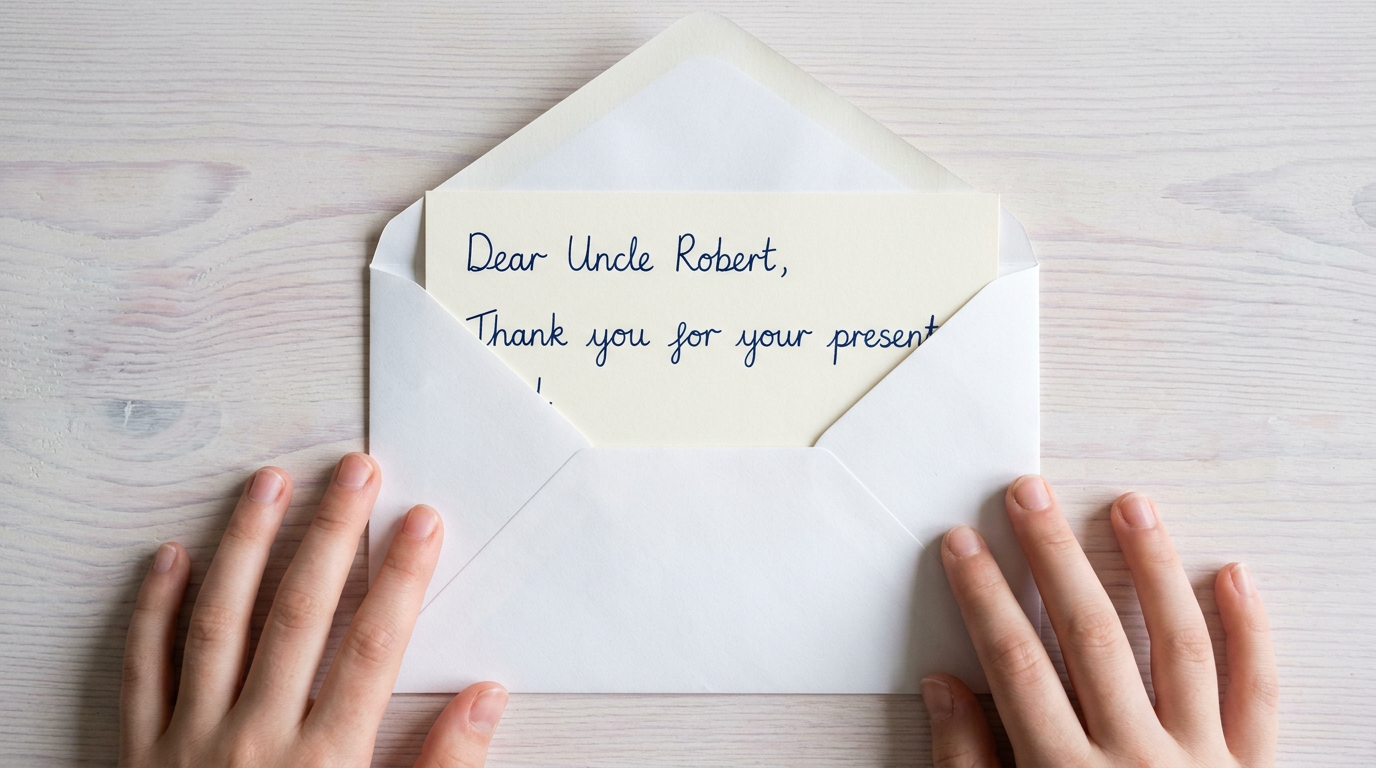
My daughter writes a thank-you note after every birthday and every Christmas. Not a text, not a voice note to a grandparent who would frankly prefer the sound of her voice anyway, a note, in her own handwriting, saying what the gift was and why she liked it. It takes her twenty minutes and she complains for most of them. I make her do it anyway, partly because I know something she doesn't yet: in a world that has mostly moved to texts and quick calls, her grandparents keep these. They're not filed away, they're kept out, a small paper proof that someone thought of them properly. That's worth twenty minutes of complaining, most weeks.
I am aware this is somewhat unfashionable. There's a certain kind of parenting conversation at the moment that treats a request like this as a small act of coercion, one more thing we make children do to satisfy the adults around them rather than anything that serves the children themselves. I have read enough of that conversation to understand its argument, and I still don't buy it. Manners were never about performing for adults. They were always about noticing that other people exist.
That is the distinction I keep coming back to. Please and thank you are not politeness for its own sake, they are the smallest possible acknowledgement that someone did something for you, and did not have to. A hello and a smile to whoever is in front of you, whether it is their grandmother or the woman at the till, is not deference, it is attention, paid outward rather than kept in. Saying goodbye properly when you leave a room, rather than simply vanishing from it, is the same instinct in miniature: you were here, you are going, and the people you were with are worth telling.
Some of what we ask of our two is more practical than philosophical, and I don't pretend otherwise. Asking to leave the table rather than sliding off it mid-conversation. Taking your own plate to the sink once you've finished. A tidy bedroom in the morning, made before school rather than left for someone else to deal with later. None of this is glamorous, and none of it needs to be, because the point was never the task itself, it was the habit of noticing that a house runs on effort that is shared, not delivered.
What I like about these small jobs is how quietly the load shifts as the children get older, without either of them clocking it. An eight-year-old taking his plate to the sink is not doing much. The same habit, five years on, in a teenager who has simply never known another way of finishing a meal, is a different thing altogether, it's a person who has absorbed, without a single conversation about it, that clearing up after yourself is simply what happens next. We have never announced this to them. We have just kept doing it, and let it compound.
The harder manners, if I'm honest, are the social ones. Letting an adult go through a door first still needs the odd reminder. Waiting for a gap in a conversation rather than talking straight through it is something my daughter, in particular, is still working on, and probably will be for a while yet, because it asks a child to hold back exactly the impulse that childhood runs on. I don't expect either of them to be finished with this at eight and nine. I do expect them to keep trying, and to notice when they haven't.
None of this happens because we asked nicely once and it stuck. Some of it is closer to Groundhog Day. Elbows off the table has been said at breakfast, lunch and dinner for what feels like years now, the same two words, on repeat, and I've stopped expecting the morning I won't need to say them. No slouching gets the same treatment. I've come to think of this less as failure and more as the actual mechanics of how a habit gets built, which is to say slowly, by repetition, with no dramatic turning point, just a parent saying the same small thing calmly enough times that eventually it stops needing to be said at all. We're not there yet. We say it again tomorrow.
The pushback is real too, and it's getting more real. There are days it feels like every small request is up for negotiation, a preview, I suspect, of the teenage years properly arriving. Some mornings I simply don't have the energy to hold every line, so I've learned to choose the fights that matter and let a few smaller ones go, which is its own kind of discipline, deciding what's worth the friction, and what isn't worth the mood it'll cost us both.
What makes it worth staying the course are the small wins, and they are small, I'll be honest. Someone mentions in passing that the children were polite. A teacher says one of them went out of their way to make the new child at school feel welcome. Neither of those moments makes the evening news in our house, no one throws a party over it, but I notice them, and I bank them, because they're the only real evidence that any of this daily repetition is landing somewhere. None of it happens by accident, and none of it happens without friction.
Some would call this strict. I'd call it consistent. There are no phones at the table, not because we are anti-screen as a matter of principle, but because a meal is one of the only points in the day when everyone is in the same place with nothing else asking for their attention, and I would rather we used it talking to each other than didn't.
A Note from Mrs H
The thank-you note, the plate in the sink, the hello at the door, none of it is really about manners at all. It's practice, repeated until it stops being practice, for being considerate, kind, and respectful of the people around them. Hopefully, better humans for it. One small step for mankind, taken at the breakfast table, elbows still occasionally on it.
— Mrs H