
Only two of 104 children’s yoghurts passed the sugar test. Here’s what the label won’t tell you, and how to check for yourself.
Yoghurt feels like one of the easy wins. A pot in the lunchbox, a bit of fruit, some calcium, one less thing to think about. Most of us would put it firmly in the healthy column without a second glance.
Action on Salt & Sugar has just tested 104 of Britain’s most popular children’s yoghurts, and only two came out low in sugar. Here’s what they found, what the rules allow, and how to check a pot for yourself.
What’s actually in the pot
The worst was Nestlé’s Smarties Vanilla Split Pot, with nearly four teaspoons of sugar in a single serving. The two that passed, a natural yoghurt from The Collective and a no-added-sugar Petits Filous, both came in just under the NHS line of 5g per 100g for “low in sugar”. Milk has a little natural sugar of its own, so anything well above that line has been added, usually as fruit purée, juice concentrate or plain sugar.
The packaging problem
What bothers me most is how these pots are sold. Cartoons, bright colours and fruit on the front all suggest a healthy choice, so it’s no wonder parents trust them. Dr Kawther Hashem of Action on Salt & Sugar puts it well:
None of this is illegal. A brand can make its yoghurt sweeter over the years, and nothing requires it to say so on the front of the pack, which is where most of us look.
What the rules don’t cover
In France, a pot can only be called yaourt if its cultures, Lactobacillus bulgaricus and Streptococcus thermophilus, are still alive when you eat it. Britain has no such rule, so the word can be used for almost anything. The red, amber and green traffic-light labels for sugar, salt, fat and calories are also voluntary here, so not every brand uses them.
What I give mine
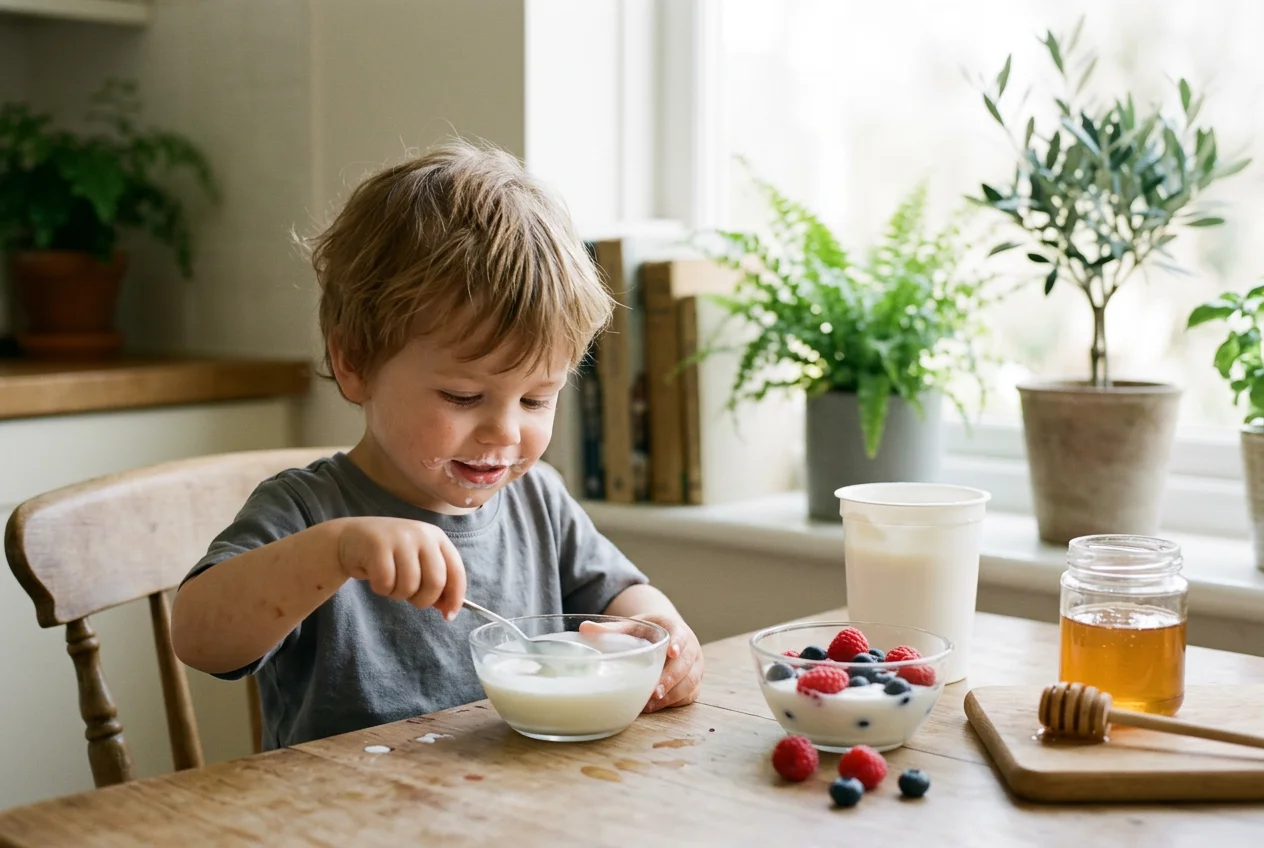
None of this means giving up yoghurt. It’s a genuinely good source of calcium and protein, and the NHS recommends plain, full-fat yoghurt for little ones. At home, we keep it simple. There’s always plain Greek yoghurt in the fridge, and the children add whatever fruit and toppings they fancy. If they want it sweeter, a spoon of honey or maple syrup goes in at the table, so I can see exactly how much they’re having.
Yoghurt is still one of the best things you can give them. It’s just worth knowing which one you’re buying.
Reading a Yoghurt Label
- Turn the pot over. The front is there to sell it; the nutrition table tells you what’s in it.
- Find the line that says “of which sugars” and look at the figure per 100g, not per pot.
- Around 5g or under is low in sugar. Much higher, and sugar has been added, so put it back and pick a plain tub instead.
None of us has time to read every label in the supermarket, and we shouldn’t have to. Learn this one, and the yoghurt aisle gets a lot simpler.
Mrs H
P.S. Have you ever turned over a pot you trusted and been surprised by what was on the back? Write to me at hello@theworldofmrsh.com.
Pieces like this arrive first in The World of Mrs H on Substack. Subscribe here.